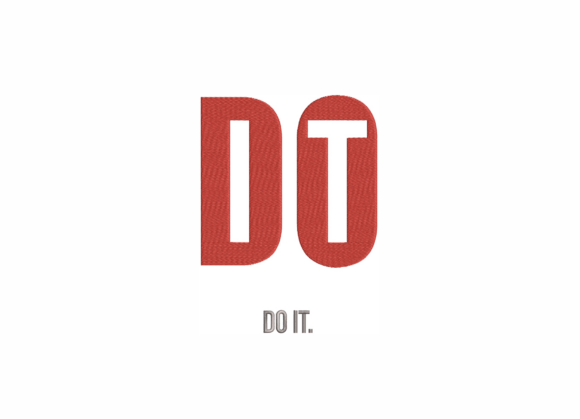
DO IT Negative Space Embroidery Design
A Craft Fair Designer’s First Impression: Bold, Modern, and Instantly Memorable
As an embroidery designer who’s prepped over 200 craft fair booths—from Portland makers’ markets to Nashville holiday bazaars—I know what stops a shopper mid-aisle. The DO IT Negative Space Embroidery Design lands with quiet confidence: not loud, not cutesy, not rustic or vintage—but modern. That clever integration of “IT” inside the bold “DO” creates visual tension and wit in under two seconds. It reads as confident, slightly playful, and undeniably handmade—not mass-produced. For Fashion and Embroidery sellers targeting creative professionals, teachers, small-business owners, and design-savvy gift buyers, this isn’t just another monogram—it’s a conversation starter.
Where It Shines: Real-World Product Performance
In my booth setup—tote bags front-and-center, aprons draped over a wooden crate, tea towels folded beside embroidered patches—the DO IT Negative Space Embroidery Design performs strongest where contrast and clarity matter most.
- Tote bag design: At 4–5 inches wide on natural canvas or heavyweight cotton duck, it reads cleanly from 6 feet away. The negative space pops without needing extra thread density—ideal for lightweight commercial embroidery runs.
- Apron embroidery: Centered above the pocket (not too high, not too low), it adds polish without overwhelming the garment’s utility. Works especially well on black, navy, or oatmeal linen-cotton blends.
- Tea towel embroidery: On tightly woven flour-sack or Belgian linen, the clean letterforms hold up beautifully—even after multiple washes. Avoid overly textured or looped terry; stitch definition suffers.
- Embroidered patch: This is where the design truly elevates. As a sew-on or iron-on patch on denim jackets or canvas pouches, it feels intentional, collectible, and brand-ready.
- Caps and curved surfaces: Proceed with caution. The tight interior of “O” and fine junctions between “D” and “IT” may distort on structured caps unless digitized with curve compensation. Test first.
- Pillow covers & market bags: Scales well at 6–7 inches—maintains legibility and gains presence without turning busy. Perfect for boutique makers wanting elevated handmade product appeal.
What Makes It Sell: Attention, Value, and Booth Impact
At a craft fair, attention is currency—and the DO IT Negative Space Embroidery Design earns it efficiently. Unlike script fonts or dense floral motifs, it’s legible at glance, emotionally resonant (“Do it!”), and subtly empowering. Buyers don’t need to pause and decode it; they feel it. That immediacy translates directly to higher conversion on small shop products.
It also lifts perceived value. A plain organic cotton tote becomes a statement piece. A simple tea towel becomes giftable. Because the design relies on precision—not fill stitches or embellishment—it signals craftsmanship. Customers associate that restraint with premium handmade quality. In booth displays, pairing three variations (e.g., black thread on cream tote, white thread on indigo apron, ecru thread on charcoal pillow cover) creates cohesive brand consistency without repetition fatigue.
Production Reality Check: What You Must Test Before Batch Runs
This isn’t a “load-and-stitch” embroidery file. Its strength lies in subtlety—and subtlety demands testing. Here’s what I verify every time:
- Test the design on scrap fabric matching your final product—especially for textured towels or thick twill. Negative space can close up if stitch density is too high or stabilizer is too light.
- Check thread contrast carefully. Light thread on light fabric? The “IT” may vanish. Dark thread on dark fabric? Same issue. Use a mid-tone thread (heather gray, olive, rust) for maximum versatility.
- Review spacing and kerning—not just on screen, but stitched. Does the “IT” visually anchor inside the “O”, or does it float? Misaligned spacing kills the illusion.
- Confirm hoop size compatibility before cutting dozens of fabric pieces. Some versions may require a 5x7 hoop minimum—tight for small pouches or kids’ caps.
- Inspect stitch density in the inner curves. Over-digitized fills in the “O” or “D” can cause puckering on lightweight fabrics. Less is more here.
- Use the right stabilizer: medium-weight cutaway for knits or stretchy fabrics; tear-away for stable wovens. Skip fusible web alone—it won’t support the structural integrity of the negative space.
- Create at least one real mockup, not just a printable mockup. Lighting, fabric drape, and hand-feel change how customers experience the finished product.
- Compare fabric colors side-by-side—what reads crisp on ivory may look muddy on ecru. Keep a physical swatch board.
- Confirm commercial licensing before selling finished products. As an Etsy seller or wholesale maker, you need explicit rights for resale—don’t assume “personal use only” covers your craft fair product line.
Careful-Use Notes: Where Clarity Fades
The DO IT Negative Space Embroidery Design loses impact in specific conditions. Avoid using it:
- Below 3 inches wide—tiny lettering blurs, and “IT” becomes indecipherable on most fabrics.
- On highly textured towels (like heavy-loop terry)—stitches sink in, erasing negative space definition.
- With dense stitch areas layered near seams or pockets—puckering distracts from the clean concept.
- On dark fabric without high-contrast thread—unless you’re intentionally going for mystery (not recommended for craft fair visibility).
- Without verifying digitization quality—if the original embroidery file compresses curves or skimps on underlay, the “negative space” effect collapses.
Final Verdict: A Strategic, Scalable, Standout Choice
For the embroidery business owner juggling Etsy listings, craft fair prep, and wholesale deadlines—the DO IT Negative Space Embroidery Design is a rare find: minimal in execution, maximal in resonance. It photographs exceptionally well for digital embroidery file listings, supports strong printable mockup variety, and scales across categories without losing identity. It’s not seasonal, not trend-dependent, and doesn’t rely on fussy details that slow down production. When executed with care—right stabilizer, smart thread choice, real-world testing—it becomes more than a machine embroidery design. It becomes a signature. And in a crowded handmade market, that’s exactly what turns browsers into buyers.